MOQ Explained: How to Get Low-Minimum Custom Sink Orders from Factories
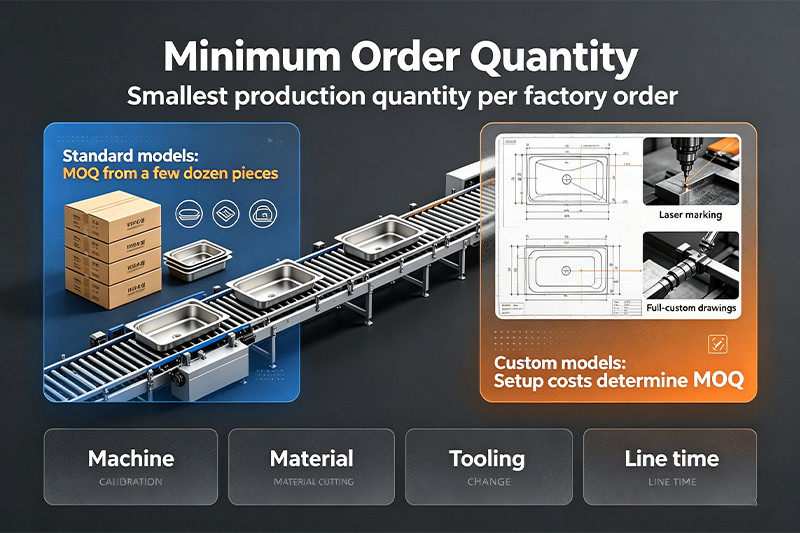
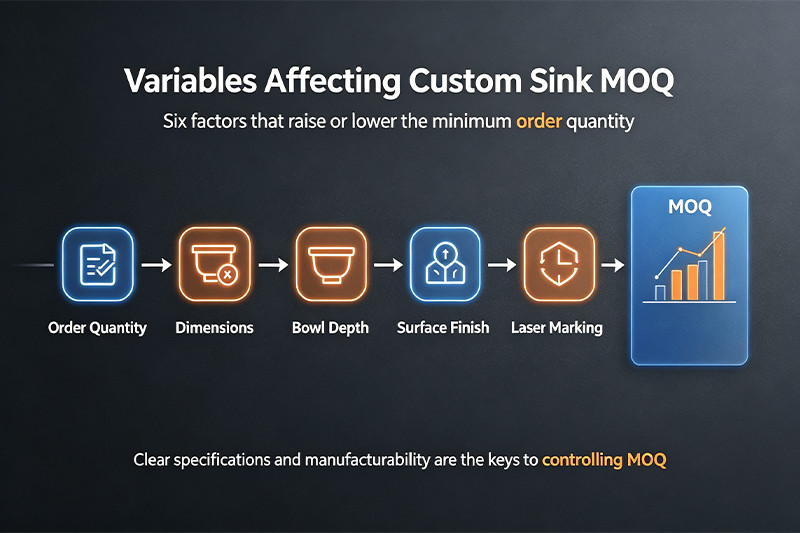
If you are a distributor, wholesaler, or private-label brand trying to launch a custom stainless steel sink line, few numbers shape your business as much as the MOQ — the minimum order quantity a factory requires. A high MOQ ties up cash, fills your warehouse with inventory you may never sell, and can kill a promising product before it reaches a single customer. The good news: MOQ is not a fixed law of manufacturing. It is a number negotiated within a factory's cost structure — and in the kitchen sink industry, smart buyers routinely secure low-minimum custom sink orders by understanding how that number is built. This guide explains what MOQ means in custom sink manufacturing, why factories set it, and the exact strategies you can use to get the smallest viable order from a sink factory. MOQ stands for Minimum Order Quantity — the smallest number of units a factory is willing to produce or sell in a single purchase order. For standard, catalog sinks, the MOQ can be a few dozen pieces. For fully custom sinks — your own dimensions, bowl depth, corner radius, finish, or laser-etched logo — the MOQ reflects the factory's setup costs: machine calibration, material cutting, tooling changes, and line time that must be spread across the batch. Any change from the factory's existing models: dimensions, gauge, finish, drain position, branding, or accessories. The more changes, the higher the setup cost per unit. Factories calculate MOQ from raw material minimums, machine setup time, labor per run, and the margin they need per order. It is an economic equation, not a rule of thumb. MOQ directly controls your upfront cash, inventory risk, and how quickly you can test a market. A low MOQ lets you validate demand before committing real capital. Factories are not trying to make your life difficult. MOQs exist because a production run carries fixed costs that do not shrink when the batch is small. Setting a realistic minimum protects the factory's margins and keeps its lines profitable. In stainless steel sink manufacturing, the main drivers are: Understanding these five drivers matters because each one points to a negotiation lever. If you can reduce tooling cost (by using an existing mold), simplify material (standard gauge), or bundle your order into the factory's schedule, you directly lower the MOQ. Not all custom sink orders carry the same MOQ. These six factors are what actually move the number up or down — and knowing them lets you design your product and order strategy to land the lowest possible minimum: Ordering a size the factory already produces means no new tooling — usually the lowest MOQ available. T304 is the industry default and easily stocked. T316 marine-grade steel costs more and is often ordered in larger lots. Brushed satin is standard. PVD colors, nano-coatings, or hand-polished finishes raise setup cost and push MOQ up. cUPC or NSF/ANSI-listed products require testing and documentation; factories usually amortize that over larger runs. Laser-etched logos and custom private-label cartons add setup steps that factories spread across volume. Ordering several models or sizes in one shipment can hit the factory's total material minimum, keeping per-SKU MOQ low. Industry benchmarks help you set expectations before you start negotiating. Based on how Chinese and Southeast Asian sink factories structure their pricing, custom stainless steel sink MOQs typically fall in these ranges: These are benchmarks, not rules. Factories with a large proprietary mold library — where your dimension already exists — can quote far lower minimums because there is no new tooling to recover. That is one of the strongest reasons to ask a factory about its mold library before you design around a brand-new size. MOQ is almost always negotiable. Experienced buyers use a combination of these tactics to bring the minimum down to a level that fits a trial launch: The simplest trade: a factory that normally runs 500 units at $30 may quote 100 units at $36. The higher margin covers the setup cost. For a market test, that premium is far cheaper than dead stock. Offer a written commitment: "100 units now, 500 in 60 days if sell-through hits target." Factories discount minimums for customers with predictable follow-up volume. Ask which sizes, depths, and finishes are already tooled. Choosing from the library eliminates tooling cost — the single biggest MOQ driver — and can drop the minimum dramatically. Standard 18-gauge T304 with brushed finish, no exotic accessories. Fewer custom specs means less setup, which means a smaller minimum. Two or three models combined can satisfy the factory's total material and schedule minimums while each SKU stays small. A larger deposit or faster payment reduces the factory's risk, and risk reduction is one of the cheapest ways to buy flexibility. A low MOQ is not a lucky outcome — it is the result of a disciplined sourcing process. Follow this sequence to maximize your chances of getting the smallest viable custom sink order: Target price, sales channel, annual volume, certifications (cUPC, NSF/ANSI), and the exact dimensions and finish you need. A clear brief gets you accurate quotes — and accurate MOQs. Look for OEM/ODM capability, export history to your market, certification expertise, and a real mold library. Ask for factory audit reports and production videos. Ask: What determines your MOQ? Is it per model or per order? Can the MOQ drop with a reorder commitment? What is the trial-order limit? Check material thickness, flatness, weld quality, finish consistency, and sound-deadening. A sample reveals more than any spec sheet — and a factory confident in its samples is more flexible on MOQ. Place the smallest approved order, measure real sell-through, then scale only proven winners. This is how modern brands keep inventory risk low while building a line. Most sourcing problems trace back to a few predictable errors. Avoid these and you will save both money and time: Meeting a 1,000-piece MOQ on day one without demand data is the classic cash trap. Start small, even if the unit price is higher. A low price with no sample is a gamble on steel grade, weld quality, and finish. Samples are cheap insurance against container-sized regrets. A sink without cUPC or NSF/ANSI listing can be unsellable in your market. Verify certifications before signing anything. Poor packaging causes damage claims and eats your margin. Confirm carton specs, drop-test standards, and damage claim processes in writing. For buyers who want custom stainless steel sinks without committing to container-sized orders, Samsink (www.samsink.com) was built around low-minimum, factory-direct programs. Founded in Foshan, China in 1995, Samsink operates dual production bases — Foshan plus a Bangkok, Thailand plant opened in 2018 — with 8 production lines, monthly capacity above 100,000 units, and a library of 500+ proprietary molds. That mold library is the key to a low MOQ: when your dimensions already exist, there is no tooling cost to amortize, and the minimum drops accordingly. Foshan manufacturing heritage Production capacity across 8 lines Proprietary tooling library For library models, OEM and ODM Samsink supplies T304 and T316 stainless steel, holds ISO9001, cUPC, and NSF/ANSI certifications, and supports full OEM/ODM customization — from laser-etched branding to private-label packaging — for more than 1,000 customers worldwide. With low MOQs, buyers can test new SKUs, launch private-label lines, and scale only what sells. Yes — when the model already exists in the factory's mold library and uses standard material and finish. That is why asking about tooling upfront matters more than asking for a discount. It depends on the factory. Some count per style, others per total order value. Clarify this before quoting, because bundling several models into one order can dramatically reduce your effective per-SKU minimum. Usually, yes. The setup cost is spread over fewer units. Compare the total cost — unit price plus inventory risk plus warehousing — rather than chasing the lowest number alone. Request mill certificates, thickness test photos, and laser markings for traceability. A reputable factory provides these without hesitation.What Is MOQ in Custom Sink Manufacturing?
What counts as custom
Who sets the number
Why it matters to you
Why Do Sink Factories Set MOQs?
Key Factors That Drive MOQ Up or Down
Standard vs. new dimensions
Material grade
Finish complexity
Certifications
Branding and packaging
Bundling multiple SKUs
Typical MOQ Ranges for Custom Kitchen Sinks
Order type Typical MOQ What drives it Stock catalog model 10–50 pcs Existing mold, standard material, no custom work Standard model, private-label logo 50–200 pcs Laser etching and carton setup Custom dimension, existing tooling 50–300 pcs New size but standard gauge and finish Fully custom design (new mold) 300–1,000+ pcs Mold amortization across the run Handmade / farmhouse with custom finish 100–500 pcs Labor-intensive welding and polishing How to Negotiate a Lower MOQ: Proven Tactics
Pay a slightly higher unit price
Commit to a reorder schedule in writing
Use the factory's existing mold library
Simplify customization
Bundle multiple SKUs into one order
Improve payment terms
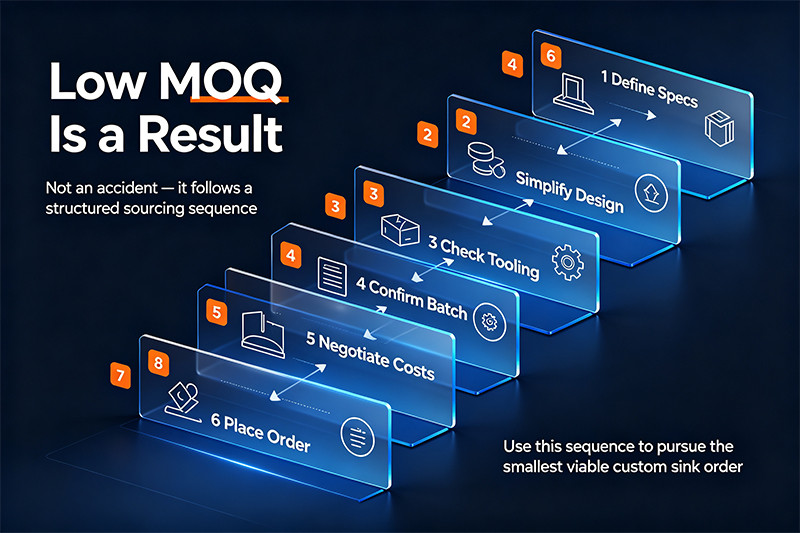
The Step-by-Step Path to Low-MOQ Custom Sink Orders
Define your procurement brief
Shortlist 3–5 qualified factories
Request quotes with MOQ transparency
Order samples and validate
Start with a trial run and scale
Common MOQ Mistakes Buyers Make
Over-ordering an unproven product
Skipping samples
Choosing price over compliance
Ignoring packaging specifications
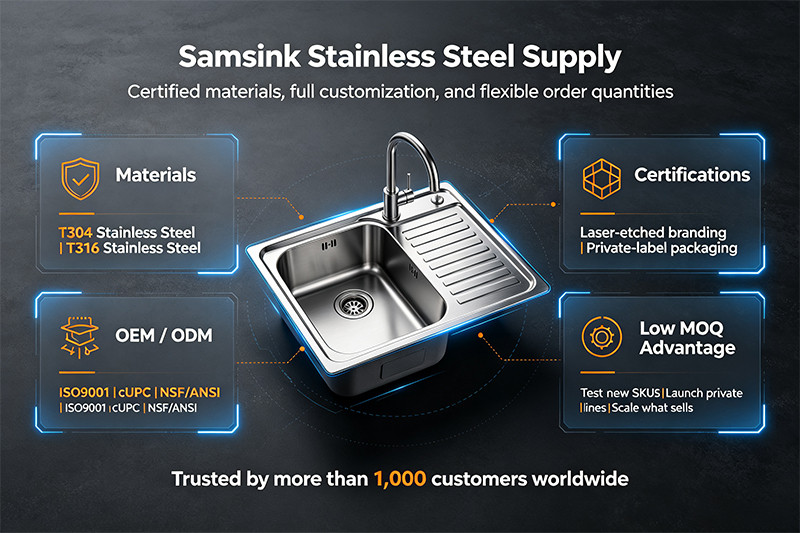
Low-MOQ Custom Sink Manufacturing: the Samsink Approach
Since 1995
100,000+ / month
500+ molds
MOQ as low as 5 pcs
MOQ FAQ: Common Questions Answered
Can a factory really quote an MOQ as low as 5 pieces?
Is the MOQ per model or per total order?
Does a low MOQ mean higher unit price?
How can I verify the steel is real T304?