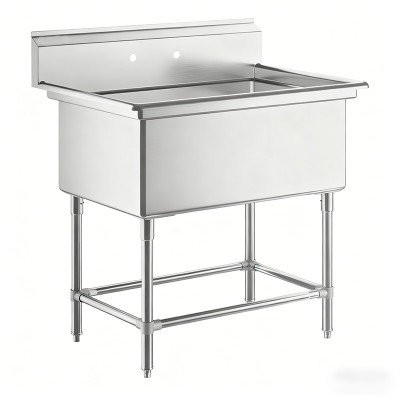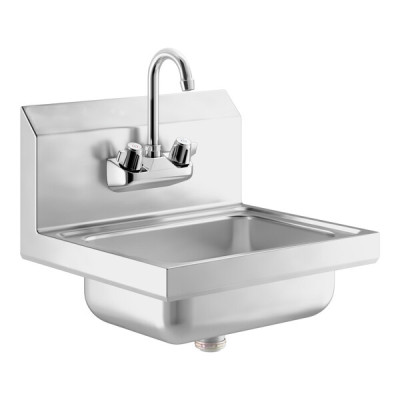
The Essential Guide to Stainless Commercial Sinks: Optimizing Hygiene and Functionality for Your Business
As business owners, we understand that maintaining peak hygiene and efficient operations is paramount in any commercial setting. This is why we often rely on robust materials like stainless steel for our equipment, including essential sinks. A commercial sink is more than just a place to wash hands and dishes; it's a critical component for ensuring kitchen cleanliness, meeting health standards, and supporting a smooth workflow. In any setting where sanitation has a direct impact on safety and compliance, such as foodservice or healthcare, the sink is a fundamental piece of equipment.
However, simply having a stainless steel sink isn't enough. In a busy environment, kitchen surfaces can quickly become breeding grounds for bacteria, and improper sink usage can lead to cross-contamination, compliance issues, and unnecessary waste. Join us as we explore how to optimize your stainless commercial sinks, ensuring they not only appear clean but actively contribute to a safe, sustainable, and highly functional workspace.
Key Takeaways
This guide provides a comprehensive framework for understanding and optimizing your commercial sink setup. Here are the crucial points for any business owner or manager:
- Hygiene is Non-Negotiable: The primary role of a commercial sink is to facilitate hygiene and prevent the spread of foodborne illnesses. Most health codes mandate specific sink configurations, such as separate sinks for handwashing and a three-compartment system for washing, rinsing, and sanitizing dishware. Failure to adhere to these regulations can result in severe penalties, including fines and business closure.
- Material and Construction Dictate Longevity: The quality of your sink is determined by its material and build. For commercial applications, 304 stainless steel is the industry standard due to its excellent corrosion resistance and durability. The gauge, or thickness, of the steel is also critical; a lower gauge number (e.g., 16-gauge) signifies thicker, more robust steel that can withstand the demands of a high-volume environment.
- Workflow and Ergonomics Boost Efficiency: A well-designed sink area enhances productivity and safety. Proper sink placement, height, and layout can create an ergonomic workspace that minimizes physical strain on staff and streamlines operations. Following a logical workflow, such as moving from a dirty area to a clean area, is essential for preventing cross-contamination.
- Dedicated Sinks Prevent Cross-Contamination: Using the same sink for multiple purposes is a major health code violation. To maintain a safe kitchen, you must have dedicated sinks for distinct tasks:
- Handwashing Sinks: For staff hygiene.
- Three-Compartment Sinks: Exclusively for the wash, rinse, and sanitize process for dishes and utensils.
- Food Preparation Sinks: For washing produce and other food-related tasks.
- Bar Sinks/Glassware Sinks: For cleaning glassware to avoid residue and ensure proper sanitation.
- Proper Maintenance is a Daily Requirement: Stainless steel is hygienic, but it is not self-cleaning. Regular cleaning protocols are necessary to prevent the buildup of grime, bacteria, and hard water deposits. A daily routine of cleaning and sanitizing not only ensures compliance but also extends the life of your equipment.
- Automation Offers a Path to Superior Hygiene and Sustainability: While traditional sinks are effective when used correctly, automated handwashing stations offer a higher level of consistency and control. These systems guarantee that every hand wash meets a specific, pre-programmed cycle, significantly reducing human error and conserving water and soap in the process. This technology represents a long-term investment in safety, compliance, and operational efficiency.
By focusing on these key areas—from initial material selection to daily maintenance and forward-thinking technology—you can transform your sink area from a simple utility into a cornerstone of your business's commitment to excellence.
The Hidden Hygiene Hurdles of Your Traditional Stainless Commercial Sink
While a stainless steel sink is a fixture of commercial kitchens, its effectiveness hinges entirely on how it's used. A traditional manual sink setup, despite its seeming simplicity, presents significant challenges to maintaining consistent hygiene and sustainability. These challenges are often rooted in human behavior and the inherent limitations of the equipment itself.
Why Manual Handwashing Falls Short
Proper handwashing is the first line of defense against foodborne illness, yet studies show that it's an area where compliance is shockingly low. The CDC outlines a clear five-step process: wet, lather, scrub for 20 seconds, rinse, and dry. However, in the fast-paced environment of a commercial kitchen, this protocol is frequently compromised.
Common mistakes that undermine hygiene include:
- Insufficient Washing Time: Many people only wash their hands for a few seconds, far short of the recommended 20 seconds needed to effectively remove pathogens.
- Incomplete Coverage: Staff often only wash their palms, neglecting critical areas like the backs of their hands, between fingers, and under fingernails, where germs can hide.
- Skipping Soap: A quick rinse with water is not enough. Soap is essential for lifting and removing oils and germs from the skin.
- Cross-Contamination at the Faucet: A major pitfall of manual sinks is re-contaminating clean hands by touching dirty faucet handles to turn off the water. This single action can undo the entire handwashing process.
- Inadequate Drying: Germs are transferred more easily to and from wet hands. Failing to dry hands completely on a clean paper towel or with an air dryer can create a breeding ground for bacteria.
Studies have observed that food handlers often fail to wash their hands when they should, with one study showing compliance in only about one out of every three necessary instances. This inconsistency is not just a matter of negligence; it's often a result of time pressure and inconveniently located handwashing stations. The entire process is dependent on human behavior, which is inherently variable and prone to error, making manual sinks an unreliable method for ensuring consistent pathogen removal.
Water Waste and Sustainability Costs
Beyond the hygiene risks, traditional manual sinks contribute to significant resource waste. When an employee follows the correct handwashing procedure, the faucet often runs continuously for the entire 20-second scrubbing duration. During this time, the majority of the water flows directly down the drain without ever touching the user's hands, leading to substantial waste.
Let's consider the numbers:
- A standard commercial kitchen faucet can have a flow rate of 2.2 to 2.5 gallons per minute (GPM) or even higher.
- If a faucet is left running for just 20 seconds during the lathering and scrubbing phase of handwashing, it can waste over half a gallon of water per wash.
- Multiplied by dozens of employees washing their hands multiple times per hour, the total water waste can amount to thousands of gallons per day in a busy restaurant.
This excessive water consumption has a dual negative impact:
- Financial Cost: High water usage directly translates to higher utility bills. Additionally, if hot water is used, there is an associated energy cost for heating that water.
- Environmental Impact: In an era of growing environmental concerns, such waste is unsustainable. Cleaning processes, including dishwashing and handwashing, rely on significant water usage, and minimizing this consumption is a key part of corporate responsibility.
Practices like leaving taps running overnight or using running water to thaw food add to this burden. While installing low-flow aerators can help reduce GPM, the fundamental problem of water running during the scrubbing phase remains. This makes it clear that while stainless steel sinks are essential, relying solely on manual operation presents considerable hurdles to achieving optimal hygiene and sustainability in a commercial setting.
Material Matters: Choosing the Right Foundation for Your Stainless Commercial Sink
When selecting a stainless steel commercial sink, the decision extends far beyond size and shape. The very materials used to construct the sink form the foundation of its durability, hygiene, and long-term value. Two key factors—the grade of the stainless steel and its gauge (thickness)—are paramount. Making an informed choice in these areas will ensure your investment withstands the rigors of a commercial environment.
Stainless Steel Grades: 304 vs. 430
Stainless steel is not a single material but a family of alloys. The "grade" refers to its chemical composition, which dictates its resistance to corrosion, its durability, and its cost. In commercial kitchens, the two most common grades you'll encounter are 304 and 430.
Type 304 Stainless Steel: Often called "18/8" for its composition of approximately 18% chromium and 8% nickel, 304 is the gold standard for food service equipment. The nickel content is crucial, as it significantly enhances corrosion resistance, particularly against acids and chlorides found in foods and cleaning agents. This makes it highly durable in wet environments like a sink area. It is also non-magnetic.
Type 430 Stainless Steel: This grade also contains chromium but lacks a significant amount of nickel. The absence of nickel makes it less expensive but also less resistant to corrosion, especially in wet or acidic environments. While Type 430 is considered food-grade for certain applications (like dry food contact or appliance paneling), it is prone to rusting if consistently exposed to moisture and not meticulously maintained. It is also magnetic.
For any sink application—handwashing, dishwashing, or food prep—Type 304 stainless steel is the superior choice. Although it comes at a higher initial cost due to the nickel, its exceptional resistance to rust and corrosion makes it a far more durable and hygienic long-term investment. A sink made from 430 steel may save money upfront but is likely to degrade, rust, and require premature replacement in a busy, wet commercial kitchen.
Comparison of 304 vs. 430 Stainless Steel
| Feature | Type 304 Stainless Steel | Type 430 Stainless Steel |
|---|---|---|
| Composition | ~18% Chromium, ~8% Nickel | ~17% Chromium, No Nickel |
| Corrosion Resistance | Excellent, especially against food acids and chlorides | Moderate; prone to rust in wet environments |
| Best Application | Sinks, countertops, food processing equipment (wet areas) | Appliance panels, decorative trim, dry storage (dry areas) |
| Hygienic Properties | Excellent, easy to clean and sanitize | Good, but susceptible to pitting/rust if not maintained |
| Magnetism | Non-magnetic | Magnetic |
| Cost | Higher | Lower |
Gauge and Construction for Durability
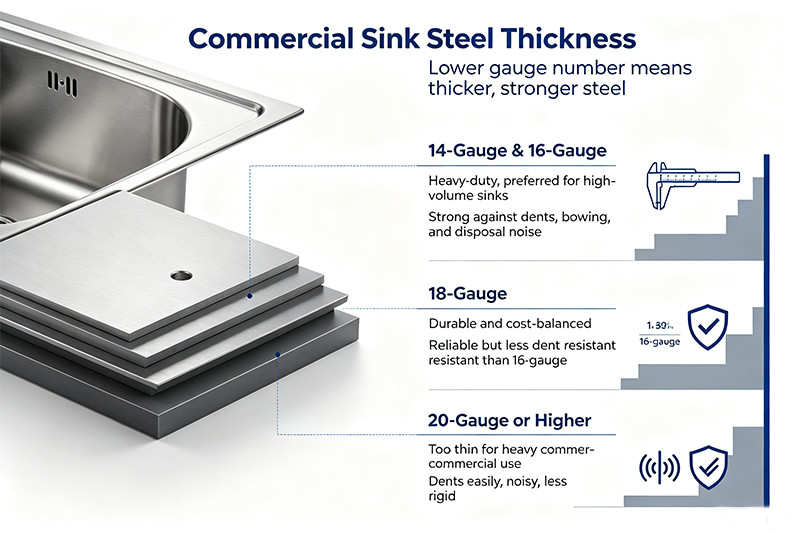
The "gauge" of stainless steel refers to its thickness, and it's a critical indicator of a sink's durability. The system works in reverse: the lower the gauge number, the thicker and stronger the steel. For example, 16-gauge steel is thicker and more robust than 18-gauge steel.
14-Gauge & 16-Gauge: This is considered heavy-duty and is the preferred thickness for high-volume commercial sinks. A 16-gauge sink offers excellent resistance to dents from dropped pots, bowing under heavy water loads, and vibrations from garbage disposals. Its thickness also helps dampen sound.
18-Gauge: This thickness represents a good balance of durability and cost and is suitable for many commercial applications. It is still a reliable option, though slightly more susceptible to denting than 16-gauge steel.
20-Gauge or Higher: Sinks with a gauge of 20 or higher are generally too thin for most commercial uses. They are prone to denting, are noisier, and lack the rigidity needed for a professional environment.
Beyond the gauge, look at the sink's overall construction. High-quality sinks feature:
- Welded Seams: Strong, smooth welds contribute to the structural integrity.
- Coved Corners: These are rounded, seamless corners inside the sink basin. Unlike sharp, 90-degree corners that trap grime and bacteria, coved corners are easy to wipe clean, significantly enhancing hygiene and simplifying maintenance.
- Reinforcement: Check for reinforcement channels or braces on the underside of larger sinks to prevent bowing and provide extra stability.
When selecting a sink, prioritizing a low gauge (like 16-gauge) and high-grade (Type 304) steel is a direct investment in the longevity and safety of your kitchen. For a truly durable and easy-to-maintain option, a sink from a reputable brand like Samsink built with these principles is an excellent choice.
Optimizing Layout and Maintenance for Your Stainless Commercial Sink Area
A high-quality stainless steel sink is only as effective as the environment it's placed in and the procedures used to maintain it. Strategic layout and rigorous, consistent cleaning protocols are essential to transform your sink area into a hub of efficiency and hygiene, rather than a bottleneck for contamination.
Ergonomics and Space Planning
The physical layout of your sink area directly impacts workflow, safety, and staff morale. A poorly designed station can lead to wasted steps, physical strain, and increased risk of cross-contamination. Thoughtful planning focuses on creating a logical, ergonomic, and compliant workspace.
Key Principles of Sink Layout:
- Workflow Direction: The most critical principle is establishing a unidirectional flow, from dirty to clean. This is especially vital for the warewashing area. Dirty dishes should arrive at one end (on a designated drainboard), move sequentially through the wash, rinse, and sanitize compartments, and then be placed on a separate, clean drainboard to air-dry. This linear path prevents clean dishes from being re-contaminated.
- Strategic Placement: Each type of sink must be placed according to its function.
- Handwashing Sinks: Must be conveniently located in all food preparation, service, and warewashing areas to encourage frequent use. Staff shouldn't have to walk across the kitchen to wash their hands.
- Food Prep Sinks: Should be situated within the food preparation zone, close to produce storage and cutting stations.
- Warewashing Sinks (3-Compartment): Should be located near the kitchen entrance/exit, allowing servers to easily drop off dirty dishes without crossing through active cooking or prep zones.
- Mop/Utility Sinks: Must be in a separate area away from food handling to prevent contamination from dirty mop water.
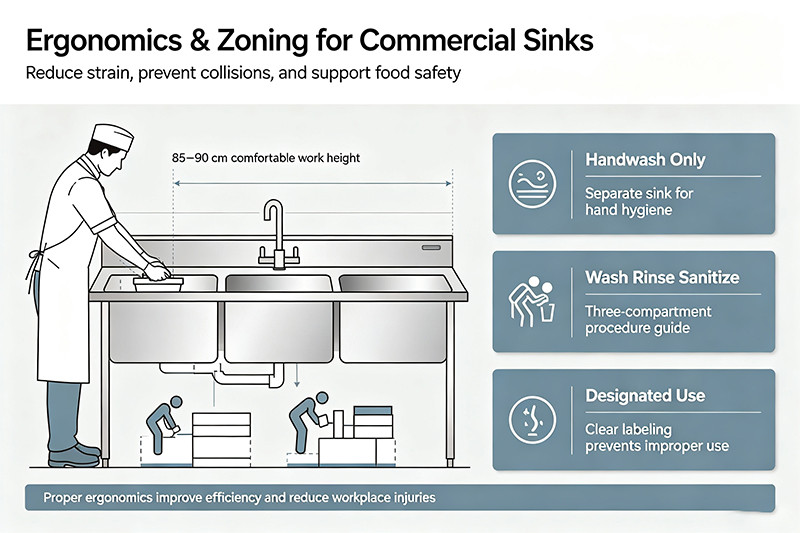
- Ergonomics: Consider the height and depth of the sink to reduce physical strain on staff. Work surfaces should be at a comfortable height (typically 85-90 cm) and walkways should be wide enough to prevent collisions. Proper ergonomics lead to greater efficiency and fewer workplace injuries.
- Clear Zoning: Labeling sinks for their specific purpose (e.g., "Handwash Only") is a simple but effective way to prevent improper use, a common health code violation. Posting visual guides for procedures, like the steps for a three-compartment sink, can also reinforce correct practices.
Essential Cleaning Protocols
Even the highest-quality stainless steel requires regular cleaning and sanitizing to maintain its hygienic surface. A passive approach can lead to the buildup of biofilms, hard water scale, and trapped food particles, creating a haven for bacteria. A robust cleaning protocol is non-negotiable.
The 5-Step Three-Compartment Sink Method:
This FDA-approved manual dishwashing process is a cornerstone of kitchen sanitation.
- Scrape: Before washing, all excess food debris must be scraped or rinsed off the dishes into a garbage disposal or waste bin.
- Wash: In the first compartment, wash the items with warm, soapy water (at least 110°F/43°C). Use a brush or cloth to scrub all surfaces and remove grease and grime.
- Rinse: In the second compartment, rinse the items thoroughly with clean, warm water to remove all detergent residue. Soap can neutralize sanitizer, making this step crucial.
- Sanitize: In the third compartment, completely submerge the items in a chemical sanitizing solution (like chlorine, iodine, or quaternary ammonium) at the correct concentration or in hot water at 171°F (77°C) for at least 30 seconds. Use test strips to verify the sanitizer's concentration.
- Air-Dry: Place sanitized items on a clean drainboard or rack to air-dry completely. Never towel-dry dishes, as this can reintroduce bacteria and other contaminants.
Daily and Regular Sink Maintenance:
Beyond dishwashing, the sinks themselves must be cleaned. At the end of each shift or, at a minimum, every four hours, the sink basins should be emptied, cleaned, and sanitized. This prevents the buildup of residue from dirty water.
What to Use (and What to Avoid):
- Do Use: Soft cloths, sponges, and mild detergents. For sanitizing, use approved chemical solutions or hot water.
- Do Not Use: Steel wool, abrasive scouring pads, or harsh chemicals like bleach, as they can scratch the stainless steel surface and damage its passive protective layer, leading to corrosion.
By combining an intelligent layout with unwavering adherence to cleaning protocols, your stainless steel sink area becomes a powerful asset in upholding your business's commitment to safety and quality. High-quality, easy-to-clean sinks, such as those from Samsink, which are often built with features like coved corners to meet NSF standards, make these maintenance tasks simpler and more effective.
Beyond the Traditional Stainless Commercial Sink: Embracing Automated Hygiene Solutions
While traditional stainless steel sinks are indispensable, their effectiveness is limited by human behavior and inherent design flaws. To achieve the highest standards of hygiene and operational efficiency, forward-thinking businesses are looking beyond manual systems and embracing automated hygiene solutions. This technological leap addresses the core challenges of inconsistency, cross-contamination, and resource waste head-on.
Automated Handwashing Technology
Automated handwashing stations are engineered to remove the variability and error associated with manual washing. These systems guide users through a perfectly executed, touch-free hygiene event every single time.
How They Work: Automated stations operate on a simple, sensor-based process:
- Activation: Infrared sensors detect when hands are placed within the washing cylinder, initiating the cycle without any physical contact.
- Soaping and Washing: The unit dispenses a pre-measured amount of soap and a precise volume of water, while rotating cylinders or high-pressure nozzles gently scrub the hands for a pre-programmed duration. This ensures all surfaces, including fingertips and areas between fingers, are thoroughly cleaned.
- Rinsing and Drying: A clean water rinse follows, removing all soap and contaminants. Many advanced models also integrate a high-speed air dryer to complete the touchless process, leaving hands fully dry and sanitized.
The Key Benefits of Automation:
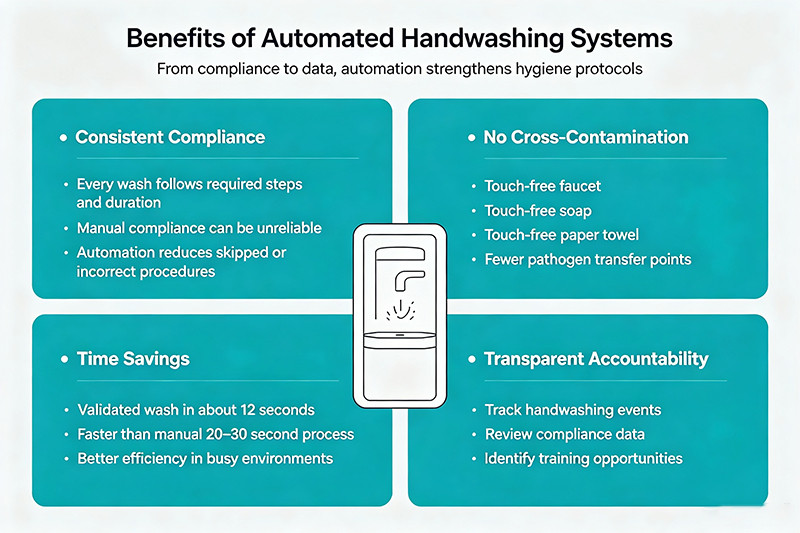
- Guaranteed Compliance and Consistency: By automating the process, these stations ensure every hand wash meets the required duration and technique, virtually eliminating human error. Studies have shown that manual handwashing compliance can be incredibly low, with some workers skipping or improperly performing the task up to 95% of the time it is required. Automation enforces the protocol every time.
- Elimination of Cross-Contamination: The entire process is touch-free. Users do not need to touch faucet handles, soap dispensers, or paper towel levers, which are all major points of cross-contamination in a manual setup. This closed-loop system dramatically reduces the risk of spreading pathogens.
- Enhanced Productivity: A complete, validated hand wash can be completed in as little as 12 seconds, significantly faster than the manual 20-30 second process. This saves valuable time in a high-traffic environment without compromising safety.
- Data and Accountability: Many modern systems feature IoT connectivity, allowing managers to track handwashing events. This data provides a clear audit trail for compliance and helps identify areas for further training or process improvement.
Smart Water Usage and Long-Term Value
One of the most compelling advantages of automated hygiene systems is their dramatic improvement in resource efficiency. By optimizing every cycle, these stations deliver significant savings on water, soap, and energy.
Quantifiable Savings:
- Water Conservation: While a manual hand wash can use up to 2.5 gallons of water (with much of it wasted down the drain), an automated station uses as little as 0.6 gallons per wash. Some studies report water savings of 30-70% after switching to touchless systems. For a facility with high handwashing frequency, this can translate to thousands of gallons saved annually.
- Reduced Soap Consumption: Automated dispensers deliver the exact amount of soap needed, eliminating the overuse common with manual pumps. This can lead to a reduction in soap expenditure by as much as 38%.
Calculating the Return on Investment (ROI): While the upfront cost of an automated handwashing station is higher than a traditional sink, the long-term value provides a strong ROI. Most commercial facilities see a return on their investment within 12 to 24 months. The calculation is based on several factors:
- Reduced Utility Costs: Lower water and energy bills.
- Lower Consumable Costs: Savings on soap and paper towels.
- Increased Labor Efficiency: Faster handwashing cycles save employee time.
- Reduced Risk and Liability: Improved hygiene reduces the risk of costly foodborne illness outbreaks, which can lead to fines, lawsuits, and reputational damage.
- Enhanced Brand Reputation: Investing in cutting-edge hygiene technology demonstrates a clear commitment to safety and professionalism, which builds trust with both customers and employees.
For businesses serious about creating the safest and most efficient environment possible, moving beyond the traditional sink is the next logical step. Automated solutions, like those offered by industry leaders, provide a reliable, sustainable, and data-driven approach to hygiene.
If you are ready to elevate your business's hygiene standards and operational efficiency, it's time to explore the benefits of automated technology. Contact a Samsink hygiene expert today to discuss how our advanced sink solutions can be tailored to meet your specific needs and deliver a clear return on investment.
Frequently Asked Questions (FAQ)
1. What is the most important factor when choosing a stainless steel grade for a commercial sink? The most critical factor is the grade's resistance to corrosion. For any "wet" application like a sink, Type 304 stainless steel is the industry standard. Its nickel content (typically 8-10%) provides superior protection against rust and corrosion from water, food acids, and cleaning chemicals. A cheaper alternative like Type 430 stainless steel lacks nickel and is far more susceptible to rusting, making it unsuitable for the demanding environment of a commercial sink.
2. What is the difference between 16-gauge and 18-gauge stainless steel, and which is better for a commercial kitchen? The "gauge" refers to the thickness of the steel, with a lower number indicating thicker, more durable metal.
- 16-gauge steel is approximately 1.59 mm thick.
- 18-gauge steel is approximately 1.27 mm thick.
For most high-volume commercial kitchens, 16-gauge is the better choice. Its superior thickness makes it more resistant to dents from heavy pots and pans, reduces noise from clatter and garbage disposals, and provides greater overall structural rigidity. While 18-gauge is still a viable option for lighter-use scenarios, the enhanced durability of 16-gauge steel makes it a wiser long-term investment for a busy operation.
3. What is the correct procedure for using a three-compartment sink? The FDA-mandated procedure for manual warewashing involves five distinct steps to ensure items are both clean and sanitized:
- Scrape: Remove all visible food debris from the item.
- Wash: In the first compartment, use hot water (at least 110°F / 43°C) and detergent to scrub the item.
- Rinse: In the second compartment, rinse the item with clean, warm water to remove all soap residue.
- Sanitize: In the third compartment, submerge the item completely in either a chemical sanitizing solution for the required contact time or in water heated to at least 171°F (77°C) for a minimum of 30 seconds.
- Air-Dry: Place the item on a clean rack or drainboard to air-dry. Never use a towel, as it can reintroduce germs.
4. Why is a dedicated handwashing sink required in a commercial kitchen? Health codes strictly prohibit using food preparation or warewashing sinks for handwashing to prevent cross-contamination. Dirty hands can transfer pathogens to sinks used for washing produce or sanitizing dishes, creating a significant food safety hazard. A dedicated handwashing sink, conveniently located in all prep and service areas, is essential for ensuring staff can wash their hands properly and frequently without compromising the safety of food and clean equipment.
5. Are automated handwashing stations worth the higher initial cost? Yes, for many businesses, they offer a significant return on investment (ROI). While the upfront cost is higher than a traditional sink, automated stations provide long-term value through:
- Guaranteed Hygiene: They eliminate human error by delivering a perfect, standardized wash cycle every time.
- Resource Savings: They use significantly less water (up to 70% less) and soap per wash, leading to lower utility and consumable costs.
- Increased Efficiency: They complete a wash cycle in as little as 12 seconds, saving valuable employee time.
- Reduced Risk: By improving hygiene compliance, they lower the risk of foodborne illness outbreaks and associated fines or reputational damage. Most facilities see a return on their investment within 12 to 24 months, making it a smart financial decision for businesses focused on safety and efficiency.
We've seen that optimizing your stainless commercial sink setup extends beyond initial cost, encompassing critical elements like material choice, proper maintenance, and advanced hygiene solutions. The foundation of a safe and efficient kitchen lies in selecting durable materials like 16-gauge, Type 304 stainless steel, which offers the best defense against the daily rigors of a commercial environment. This choice must be supported by a well-designed ergonomic layout that promotes a logical workflow and strict adherence to daily cleaning and sanitizing protocols.
Furthermore, we must recognize the limitations of manual processes and look toward the future. Embracing automated hygiene technology is not just an upgrade; it's a strategic move to enforce compliance, conserve resources, and eliminate the risks associated with human error. By making informed decisions about our equipment and processes, we can ensure our businesses benefit from superior hygiene, enhanced functionality, and a committed to sustainability. This elevates not only our workspace but also the safety and trust of our customers. We encourage you to review your current sink stations and consider where improvements can be made.
Feel free to share this guide with your team and colleagues to foster a stronger culture of hygiene and efficiency in your workplace. What changes will you implement first?