What Defines a Leading Stainless Steel Sink Factory?
We often encounter stainless steel sinks in our daily lives, from homes to bustling commercial kitchens. These aren't just simple basins; they are critical components that demand high quality and durability. But have you ever wondered what truly sets apart an ordinary factory from a leading stainless steel sink factory?
Choosing the right manufacturer is a fundamental decision for any business, especially when it comes to long-lasting equipment like stainless steel sinks. A superior sink is a synthesis of premium materials, advanced engineering, and meticulous craftsmanship. In this blog, we will delve into the essential characteristics that define a top-tier stainless steel sink factory, helping you understand what to look for and how a partner like Samsink embodies these principles.
Key Takeaways
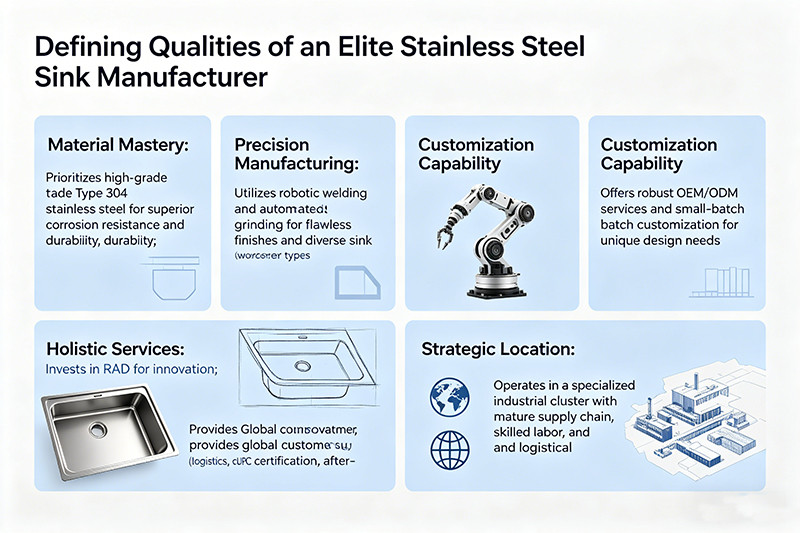
For those looking for a quick overview, here are the defining qualities of an elite stainless steel sink manufacturer:
- Material Mastery: Prioritizes high-grade stainless steel, primarily Type 304, for its superior corrosion resistance and durability. They maintain stringent sourcing standards from reputable mills to ensure material consistency and quality.
- Precision Manufacturing: Utilizes advanced automation, including robotic welding and automated grinding, to achieve flawless finishes and perfect geometry. This technological prowess allows them to produce a diverse range of sink types, from workstation sinks to specialized commercial models.
- Customization Capability: Offers robust OEM (Original Equipment Manufacturer) and ODM (Original Design Manufacturer) services, empowering other brands. They also possess the flexibility for small-batch customization to meet unique architectural and design needs.
- Holistic Services: Invests heavily in Research & Development (R&D) to drive innovation in functionality and design. A global-facing factory provides comprehensive customer support, including expert logistics, international certification compliance (like cUPC), and responsive after-sales service.
- Strategic Location: Operates within a specialized industrial cluster, leveraging a mature supply chain, a skilled labor force, and logistical efficiencies. This geographic advantage translates into cost-effectiveness, quality, and innovation.
Unveiling the Material Expertise of a Top Stainless Steel Sink Factory
The foundation of any exceptional stainless steel sink is, unsurprisingly, the steel itself. A leading factory distinguishes itself not just by the products it makes, but by the materials it chooses. This commitment to quality starts with a deep understanding of metallurgy and a refusal to compromise on the raw materials that form the very core of their products.
The Crucial Choice: Understanding 201 vs. 304 Stainless Steel for Sink Durability
Not all stainless steel is created equal. The grade of the steel is a critical factor that directly impacts a sink's lifespan, appearance, and safety. A premier factory's expertise is immediately evident in its choice between the two most common grades: 201 and 304.
Type 304 Stainless Steel: Often referred to as 18/8 stainless steel, this grade contains approximately 18% chromium and 8% nickel. This composition is the gold standard for kitchen and commercial sinks. The high nickel and chromium content creates a passive, protective layer on the steel's surface, giving it exceptional resistance to rust, corrosion, and oxidation. It stands up well against common kitchen acids (like those from lemons or tomatoes), harsh detergents, and the general humidity of a kitchen environment. For this reason, 304 stainless steel is the preferred choice for high-contact equipment where hygiene and durability are paramount. A factory committed to quality, like Samsink, will almost exclusively use Type 304 steel for its sinks.
Type 201 Stainless Steel: This is a lower-cost alternative where much of the expensive nickel is replaced with more affordable manganese and nitrogen. While it may look shiny and new initially, 201 steel has significantly weaker corrosion resistance. It is far more susceptible to rust, pitting, and staining, especially when exposed to moisture, salts, or acidic substances. Sinks made from 201 steel might be cheaper upfront, but they often lead to a much shorter lifespan and potential hygiene issues as the surface degrades. A top-tier factory understands that the long-term cost of a failing product is far greater than the initial savings on material.
Here is a clear comparison:
| Feature | 304 Stainless Steel | 201 Stainless Steel |
|---|---|---|
| Composition | ~18% Chromium, ~8% Nickel | ~17% Chromium, ~4.5% Nickel, High Manganese |
| Corrosion Resistance | Excellent | Poor to Fair |
| Durability & Lifespan | Very High, long-lasting | Low, prone to early failure |
| Cost | Higher initial cost | Lower initial cost |
| Best Application | All kitchen & commercial sinks | Decorative items, dry environments |
| Hygienic Properties | Excellent, non-porous | Can become porous and harbor bacteria when corroded |
Why Premium Steel Sourcing Matters to a Leading Stainless Steel Sink Factory
Even when specifying Type 304 steel, not all sheets are created equal. The quality of raw materials can vary significantly, which is why a leading factory places immense emphasis on its sourcing strategy. The success and durability of the final product depend heavily on the quality of the materials chosen at the very beginning.
A top-tier manufacturer establishes long-term relationships with globally recognized and reputable steel mills, such as POSCO or TISCO. These premier suppliers are known for their stringent quality control and advanced production technologies, which result in a more consistent and reliable product. Sourcing from such mills ensures several key advantages:
- Chemical Composition Consistency: Premium mills guarantee that every batch of steel meets the precise chemical specifications for Type 304, ensuring consistent anti-corrosion and performance properties.
- Uniform Thickness and Finish: High-quality steel sheets have uniform thickness and a flawless surface, which is critical for the subsequent manufacturing processes of pressing and welding. Inconsistent thickness can lead to weak spots and deformation.
- Traceability and Certification: Reputable sources provide complete traceability and material certifications. This documentation is a guarantee of quality and is often required for international standards and export, providing customers with peace of mind.
Furthermore, a leading factory doesn't just trust its suppliers; it verifies. Implementing a rigorous Incoming Quality Control (IQC) process is non-negotiable. This involves inspecting raw materials upon arrival to ensure they meet strict performance, safety, and longevity standards. This may include using tools like a spectrometer to analyze the steel's elemental composition, ensuring that the factory is truly getting the 18/8 chromium-nickel content it paid for. This meticulous attention to sourcing and verification is a hallmark of a factory dedicated to excellence and brand reputation.
Precision and Innovation: The Core of a Leading Stainless Steel Sink Factory's Production
Beyond materials, the manufacturing process itself is where a leading factory truly shines. It's a world where precision engineering meets innovative technology. The goal is to transform a flat sheet of high-quality steel into a functional, durable, and aesthetically pleasing sink. Mediocre factories produce sinks; leading factories craft them with an obsession for detail.
The Role of Automation and Advanced Grinding in Modern Sink Manufacturing
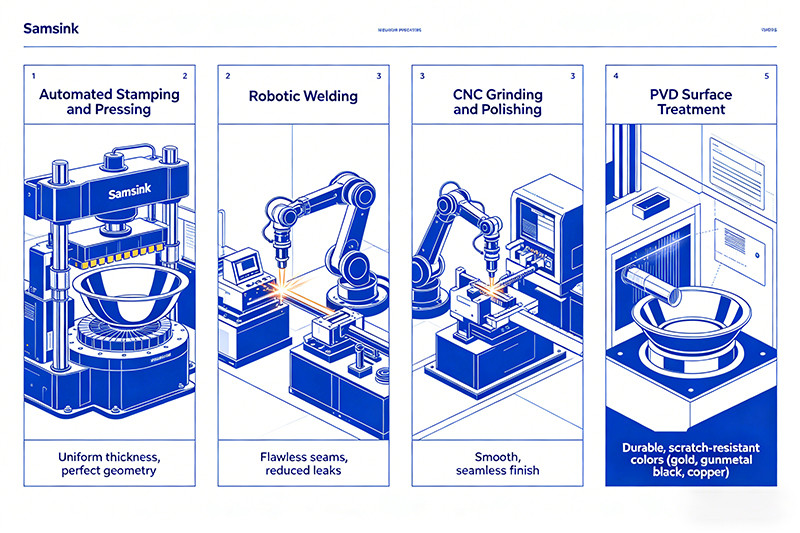
Modern sink production has moved far beyond simple manual labor. Leading factories like Samsink heavily invest in automation to ensure unparalleled precision and consistency. This technology is visible in several key stages of production:
- Automated Stamping and Pressing: For drawn sinks, massive hydraulic presses are used to stretch a single sheet of steel into a bowl shape. This automated process ensures every sink has uniform thickness and perfect geometry, which is crucial for proper drainage and fitting.
- Robotic Welding: For handmade or multi-bowl sinks, robotic welding arms perform flawless, consistent welds. Automated laser welding, in particular, offers high speed and minimal heat input, which prevents deformation and creates a stronger, cleaner seam than manual methods. This significantly reduces the chance of leaks and creates an aesthetically clean look.
- CNC Grinding and Polishing: The finishing of a sink is arguably as important as its construction. An elite factory utilizes Computer Numerical Control (CNC) grinding machines. These machines use abrasive belts and programmed paths to grind and polish welded seams and surfaces with perfect consistency. The result is a smooth, seamless transition between the bowl and the panel, leaving no crevices where bacteria can hide. This process ensures a uniform and beautiful finish—be it a classic brushed satin or a mirror polish—that is difficult and time-consuming to achieve manually.
Beyond the standard finish, innovation-driven factories are also masters of advanced surface treatments like PVD (Physical Vapor Deposition). This is a high-tech vacuum coating process that fuses a thin layer of metallic or ceramic material onto the stainless steel surface. It is not a paint or a plating. PVD is known for its exceptional durability and resistance to scratches, chipping, and fading. This technology allows for a stunning array of colors—such as gold, gunmetal black, and copper—while maintaining the hygienic and resilient properties of the underlying steel. Offering durable PVD finishes is a clear sign of a factory that is at the forefront of both technology and design trends.
Crafting Diverse Types: From Single Bowl to Wall-Mounted Designs by a Skilled Stainless Steel Sink Factory
A factory's production capability is best demonstrated by the variety and complexity of the sinks it can produce. A leading manufacturer has the engineering depth and flexible production lines to craft a wide array of sink types, catering to diverse residential and commercial needs. They are not limited to one style but can expertly produce a full spectrum of designs.
Here are some of the key types a skilled stainless steel sink factory can deliver:
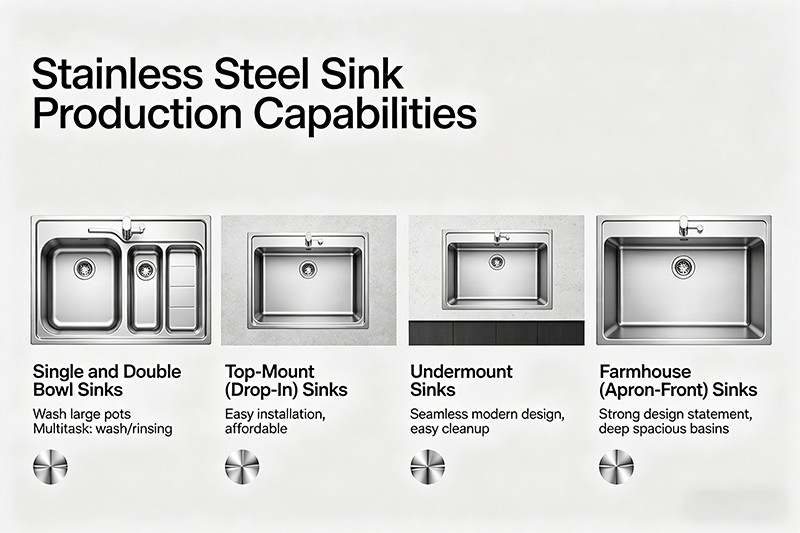
- Single and Double Bowl Sinks: These are the timeless standards. A single bowl is great for washing large pots and pans, while a double bowl allows for multitasking, like washing in one basin and rinsing in the other.
- Top-Mount (Drop-In) Sinks: These sinks have a visible rim that rests on the countertop. They are easier and more affordable to install, fitting into a simple cutout.
- Undermount Sinks: Mounted beneath the counter, these sinks create a seamless, modern look. This installation makes countertop cleanup easy, as crumbs and spills can be wiped directly into the sink without being caught on a lip.
- Farmhouse (Apron-Front) Sinks: Characterized by a large, forward-facing front panel (the "apron"), these sinks make a strong design statement. They offer deep, spacious basins perfect for heavy-duty tasks and are a centerpiece in rustic, traditional, or transitional kitchens.
- Workstation Sinks: This is a hallmark of an innovative factory. A workstation sink has built-in ledges that support sliding accessories like cutting boards, colanders, and drying racks. This highly functional design turns the sink into a complete food prep and cleaning zone, saving valuable counter space and streamlining kitchen workflow.
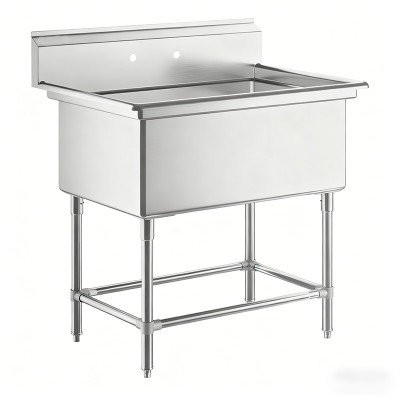
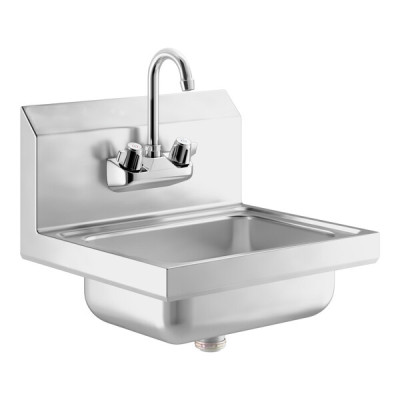
- Commercial and Wall-Mounted Sinks: A competent factory also serves the demanding commercial sector. This includes producing heavy-duty
3 compartment stainless steel sinks, which are essential in restaurant kitchens for the required wash-rinse-sanitize process to meet health codes. They also manufacture specialized designs like wall-mounted hand wash sinks and janitorial sinks, all built for extreme durability and ease of sanitation.
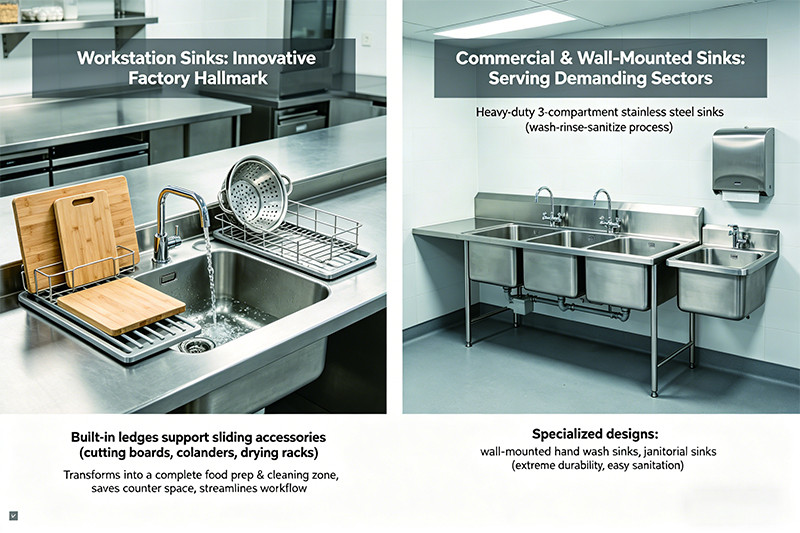
The ability to produce this wide range of products, from sleek undermount designs to robust commercial units, showcases a factory's mastery over different fabrication techniques, including pressing, bending, and welding, and its capacity to meet the evolving demands of the market.
Tailored Excellence: How a Premier Stainless Steel Sink Factory Meets Customization Needs
The true measure of a factory's leadership extends beyond its standard product catalog. It lies in its ability to adapt, innovate, and collaborate directly with clients to create bespoke solutions. A premier stainless steel sink factory acts as a strategic partner, offering tailored services that empower other brands and bring unique architectural visions to life.
Empowering Brands with OEM and ODM Solutions for Commercial Stainless Steel Sinks
For many businesses, particularly those in the commercial and hospitality sectors, off-the-shelf products are not enough. A mark of a truly advanced factory is its robust support for OEM and ODM solutions, which allow other companies to bring their unique products to market efficiently.
OEM (Original Equipment Manufacturer): This is a service where the factory manufactures products based on a design and specifications provided by the client. The client owns the intellectual property and design, and the factory acts as the production arm. This is ideal for brands that have in-house design teams but lack manufacturing facilities. A leading OEM partner like Samsink provides engineering consultation, prototyping, and rigorous quality control to ensure the final product perfectly matches the client's vision and brand standards.
ODM (Original Design Manufacturer): In this model, the factory offers its own pre-designed products that a client can then brand and sell as their own. This is an excellent solution for companies that want to launch a product line quickly without investing heavily in research and design. A a premier factory will have a catalog of innovative and market-tested designs—from unique workstation sinks to specialized commercial units—ready for branding.
The table below outlines the key differences and benefits:
| Aspect | OEM (Original Equipment Manufacturer) | ODM (Original Design Manufacturer) |
|---|---|---|
| Design Ownership | Client provides and owns the design | Factory provides and owns the initial design |
| Customization Level | High (fully based on client specs) | Low (minor modifications like branding, packaging) |
| Time to Market | Longer (requires design, tooling, and testing) | Shorter (based on existing, proven products) |
| Client Investment | Higher (involves R&D and mold creation) | Lower (leverages factory's existing R&D) |
| Ideal For | Brands with unique product visions and design capabilities | Brands wanting to quickly expand their product line |
By offering both OEM and ODM services, a leading factory becomes an indispensable partner in the supply chain. It empowers other businesses to build their brands, differentiate themselves in a crowded marketplace, and respond swiftly to consumer demands, especially for high-demand items like durable commercial stainless steel sinks.
The Advantage of Small Batch Customization from an Adaptive Stainless Steel Sink Factory
While mass production is geared towards efficiency and volume, there's a growing demand for unique, non-standard solutions. An adaptive and truly customer-centric stainless steel sink factory distinguishes itself by offering small-batch customization. This service is a game-changer for clients who need something beyond the standard catalog.
Unlike traditional manufacturing, which often requires massive minimum order quantities (MOQs) to be cost-effective, a factory with flexible manufacturing capabilities can produce a small number of custom units without a prohibitive increase in cost. This adaptability is made possible by:
- Agile Production Lines: The ability to quickly reconfigure machinery and processes for different designs.
- Skilled Craftsmanship: Relying on experienced artisans, especially for handmade sinks where precision bending, welding, and finishing are done by hand. This is essential for creating unique shapes or sinks with zero-radius corners.
- Advanced Tooling: Utilizing CNC laser cutters and press brakes that can be programmed for custom dimensions without the need for expensive, dedicated molds.
Who benefits from this service?
- Architects and Interior Designers: For high-end residential or commercial projects where a standard sink would compromise the design vision. This could be a sink with unique dimensions, an integrated countertop, or a specific corner radius to match other elements in the room.
- Boutique Builders and Remodelers: Who cater to clients with very specific tastes and a desire for one-of-a-kind fixtures.
- Specialized Commercial Clients: Such as a laboratory requiring a sink made of 316L stainless steel with custom fittings, or a restaurant needing a bar sink with unique integrated ice bins and glass rinsers to fit a non-standard space.
- Brands Testing the Market: A company can order a small batch of a new design to gauge customer interest before committing to a large production run.
By offering low-MOQ customization, a factory like Samsink demonstrates that it is not just a mass producer, but a flexible and innovative partner willing to collaborate closely with clients to solve unique challenges. Some handmade sink processes can even support an MOQ as low as five pieces, making true custom fabrication accessible.
Beyond Manufacturing: The Comprehensive Services Offered by a Leading Stainless Steel Sink Factory
A top-tier stainless steel sink factory understands that its role doesn't end when a product rolls off the assembly line. The most reputable manufacturers position themselves as long-term partners, investing in the future of their industry and providing comprehensive support that ensures client success. This forward-thinking approach is built on two pillars: relentless innovation and world-class customer service.
Investing in Research and Development: The Path to Innovative Stainless Steel Sink Designs
Static factories produce; leading factories invent. A significant portion of a premier factory's resources is dedicated to a robust Research and Development (R&D) department. This investment is not an expense but a strategic commitment to staying ahead of the curve. It signals that the factory is focused on long-term industry leadership rather than short-term production gains.
The fruits of R&D are evident in the innovative features that redefine what a sink can do:
- Advanced Surface Coatings: A key area of innovation is the development of advanced coatings. Nano-coatings, for example, create a hydrophobic (water-repellent) and oleophobic (oil-repellent) surface. This makes the sink incredibly easy to clean, as water, oil, and grime simply slide off instead of sticking. These coatings also provide enhanced scratch resistance and anti-bacterial properties, improving both durability and hygiene.
- Superior Sound-Dampening Technology: In response to the noise issue in many thin stainless steel sinks, leading manufacturers have engineered sophisticated soundproofing systems. This goes beyond a simple spray-on undercoating. Modern noise reduction involves thick, heavy-duty rubber or composite pads applied to the sink's exterior to absorb vibrations from running water and clattering dishes. This multi-layer approach transforms a noisy sink into a quiet workspace, a particularly valued feature in open-concept homes.
- Ergonomic and Functional Designs: R&D drives the creation of more user-friendly sinks. This includes perfecting the subtle slope of the sink bottom for better drainage, designing offset drains to free up more usable space in the cabinet below, and developing the integrated ledge systems found in modern workstation sinks.
- Smart and Integrated Features: Looking to the future, R&D is exploring the integration of smart technology. This includes concepts like touch-activated faucets, integrated water filtration systems, and even voice-controlled features, turning the humble sink into an intelligent kitchen hub.
By consistently pushing the boundaries of material science, functionality, and design, an R&D-focused factory like Samsink not only offers better products today but also shapes the kitchens of tomorrow.
Global Reach and Dedicated Customer Support from an Export-Oriented Stainless Steel Sink Factory
Manufacturing a great product is only half the battle. In today's global market, especially for B2B buyers, the quality of service is just as important as the quality of the product. A leading export-oriented stainless steel sink factory transforms itself from a simple supplier into a strategic global partner by offering comprehensive, dedicated support.
This involves several key areas:
Experienced Global Logistics Team: International shipping is complex, involving customs clearance, duties, freight management, and country-specific documentation. A top-tier factory has an experienced in-house logistics team that manages this entire process, ensuring that products arrive safely, on time, and without costly delays or compliance issues. They provide transparent tracking and handle the intricacies of global trade so the client doesn't have to.
International Certification and Compliance: Different markets have different mandatory standards. For plumbing products sold in the United States and Canada, cUPC certification is essential. This mark, issued by the IAPMO, certifies that a product meets the safety, durability, and performance requirements of the Uniform Plumbing Code. Without it, a sink cannot be legally installed in many North American projects. An expert factory ensures its products carry the necessary certifications for its target markets, be it cUPC for North America, CE for Europe, or WaterMark for Australia. This proactive compliance is a major indicator of a professional, export-focused operation.
Dedicated, Multilingual Customer Support: Clear communication is vital. An elite factory has a professional, multilingual customer service team available 24/7 to handle inquiries, provide technical information, and resolve issues promptly. B2B buyers expect a high level of responsive support, and a dedicated team ensures that language barriers and time zone differences do not hinder collaboration.
Comprehensive After-Sales Service: The relationship doesn't end upon delivery. A leading manufacturer stands by its products with a robust after-sales support system. This includes handling warranty claims, providing technical assistance for installation, and offering long-term support. In the B2B world, where one faulty product can disrupt a large project or supply chain, this level of accountability and long-term support is crucial for building trust and ensuring client retention.
By investing in these comprehensive services, the factory demonstrates a deep commitment to its clients' success, making the partnership smooth, reliable, and profitable for both sides.
Strategic Advantage: The Geographic Edge of a Competent Stainless Steel Sink Factory
In manufacturing, "where" a product is made can be just as important as "how" it is made. The geographic location of a factory is a strategic decision that has profound effects on its efficiency, innovation, and cost-effectiveness. A leading stainless steel sink factory is often situated in a region that offers a distinct competitive advantage, leveraging a powerful ecosystem that ultimately benefits the customer.
China's Role in High-Quality Stainless Steel Sink Manufacturing and Production Hubs
For decades, the "Made in China" label was often associated with low-cost, mass-produced goods. However, this perception is outdated. Today, China is a global powerhouse for high-quality, technologically advanced manufacturing. The country's stainless steel industry, in particular, has evolved to become a world leader in producing premium sinks for the global market.
Several factors contribute to China's dominant role:
- A Mature and Integrated Supply Chain: China is the world's largest steel producer, providing immediate and cost-effective access to high-quality raw materials. Major manufacturing regions, such as Guangdong and Fujian provinces, have developed a highly concentrated and complete supply chain. This means everything from raw steel coils to specialized components like sound-dampening pads, drain assemblies, and even advanced machinery is available locally. This proximity reduces transportation costs and lead times significantly.
- A Large and Skilled Workforce: Decades of manufacturing experience have created a vast pool of skilled labor, including engineers, technicians, and craftspeople who are experts in metal fabrication, from precision welding to hand polishing.
- Investment in Technology and Infrastructure: Chinese factories have heavily invested in modern automation, including robotic welding, CNC machinery, and advanced PVD coating lines. This investment allows them to produce high-quality, consistent products at a massive scale. Furthermore, the country's world-class port and logistics infrastructure facilitate efficient and reliable exports to every corner of the globe.
- Scale and Cost-Effectiveness: The immense scale of production in China leads to economies of scale that are difficult to match elsewhere. By choosing the right manufacturing partner, buyers can source sinks that meet the highest international quality standards at a competitive price point.
Leading Chinese manufacturers have moved beyond simple imitation and are now driving innovation. They are not just producing sinks; they are engineering sophisticated kitchen solutions and exporting them to over 150 countries. This shift from "manufacturing" to "intelligent manufacturing" is why China remains a top choice for sourcing high-quality stainless steel sinks.
The Benefits of a Stainless Steel Sink Factory Located in a Specialized Industrial Cluster
Beyond the factory walls, the surrounding industrial ecosystem plays a huge role in its success. Leading manufacturers are often strategically located in industrial clusters—geographic concentrations of interconnected companies, suppliers, and institutions in a specific field. For a stainless steel sink factory, being part of such a cluster, like those in China's Guangdong province, provides a powerful competitive advantage.
The benefits are extensive and create a positive feedback loop of efficiency and innovation:
- Supply Chain Proximity and Efficiency: Being located within a cluster means suppliers of raw materials (steel coils), components (drain assemblies, sound-dampening pads), and even specialized machinery are just a short distance away. This drastically reduces transportation costs, shortens lead times, and allows for just-in-time inventory management, making the entire supply chain more resilient and cost-effective.
- Access to a Specialized Labor Pool: Industrial clusters attract and develop a workforce with specialized skills. A factory in a metalworking hub has access to a deep pool of experienced engineers, welders, machine operators, and technicians, which is crucial for maintaining high standards of quality and craftsmanship.
- Knowledge Spillover and Innovation: When competitors, suppliers, and research institutions are located in close proximity, it fosters an environment of intense competition and collaboration. This "knowledge spillover" accelerates innovation. New techniques, market trends, and technological breakthroughs spread quickly, pushing every company in the cluster to continually improve. A factory in this environment is more likely to be at the forefront of new designs and technologies.
- Enhanced Logistical Infrastructure: These clusters are supported by robust infrastructure, including major highways, railways, and international ports. This logistical efficiency is critical for an export-oriented factory, enabling it to ship products to global markets quickly and reliably.
Ultimately, locating within an industrial cluster is not an accident; it's a strategic choice. For a company like Samsink, it means being able to leverage this powerful ecosystem to produce higher-quality sinks more efficiently and innovatively, a benefit that is passed directly on to its customers worldwide.
Frequently Asked Questions (FAQ)
1. What is the best gauge for a stainless steel sink? The "gauge" of stainless steel refers to its thickness—the lower the number, the thicker the steel. For residential kitchens, 16 or 18 gauge is highly recommended. This thickness provides excellent durability, resistance to dents, and better sound insulation. For heavy-duty commercial use, 14 or 16 gauge is often preferred for maximum strength.
2. How do I prevent my stainless steel sink from scratching? While high-quality T304 stainless steel is very durable, it can still be scratched. To minimize scratches, it's best to use a stainless steel bottom grid or a silicone mat to protect the sink's surface from direct contact with pots and cutlery. Always rinse the sink after use to remove acidic food residues and avoid using abrasive scouring pads or harsh chemical cleaners.
3. What is the difference between a handmade sink and a pressed sink? A pressed sink (or drawn sink) is made by using a large hydraulic press to stamp a single sheet of stainless steel into a mold. This method is efficient for mass production and typically results in sinks with rounded corners. A handmade sink is crafted by cutting, bending, and welding separate pieces of steel. This process allows for more design flexibility, including sharp, zero-radius corners and custom dimensions. Leading factories like Samsink are proficient in both manufacturing methods.
4. Is a PVD coated sink durable? Yes, a PVD (Physical Vapor Deposition) coating is extremely durable. Unlike paint or plating, PVD is a process that molecularly bonds a thin layer of metallic or ceramic material to the stainless steel. The resulting finish is highly resistant to scratches, abrasion, and fading. While it's not completely immune to damage from very sharp objects, it is one of the most resilient and long-lasting methods for coloring stainless steel sinks.
5. Why is cUPC certification important for a sink? cUPC certification is a standard for plumbing products in the North American market (USA and Canada). It signifies that a sink has been independently tested and complies with established standards for safety, durability, and health codes. For builders, contractors, and homeowners, choosing a cUPC-certified sink ensures that the product is legally compliant for installation and is guaranteed to be a safe, high-quality fixture.
Conclusion
Ultimately, a leading stainless steel sink factory is more than just a place where products are made; it's a hub of innovation, quality, and dedicated service. We've explored how material expertise, advanced manufacturing, customization capabilities, comprehensive support, and strategic location all play vital roles in defining an industry leader. From the meticulous selection of Type 304 stainless steel and the precision of robotic welding to the forward-thinking investment in R&D, every element contributes to a superior final product.
By understanding these defining characteristics, businesses can make incredibly informed decisions when sourcing stainless steel sinks. This knowledge ensures you partner not just with a supplier, but with a manufacturer who meets the highest standards of performance, reliability, and ultimately, success. When you choose a factory that embodies these principles, you are investing in a partnership built on trust and excellence.
We hope this deep dive has been insightful. What do you consider the most important factor when choosing a stainless steel sink manufacturer? Share your thoughts in the comments below