Home / All / Buyer's Guides / OEM vs ODM Sink Projects: Drawing -> Sample -> Mold -> Mass Production
OEM vs ODM Sink Projects: Drawing -> Sample -> Mold -> Mass Production
Nov 5,2026
Direct answer: OEM and ODM are two ways to buy the same manufacturing pipeline. In an OEM project you own the design and the factory builds it to your drawings; in an ODM project the factory owns an existing, proven design and you brand and modify it. Both models pass through the same four gates — drawing → sample → mold → mass production — and most cost overruns and delays are created at the drawing-freeze and T1-sample gates, not on the production line.
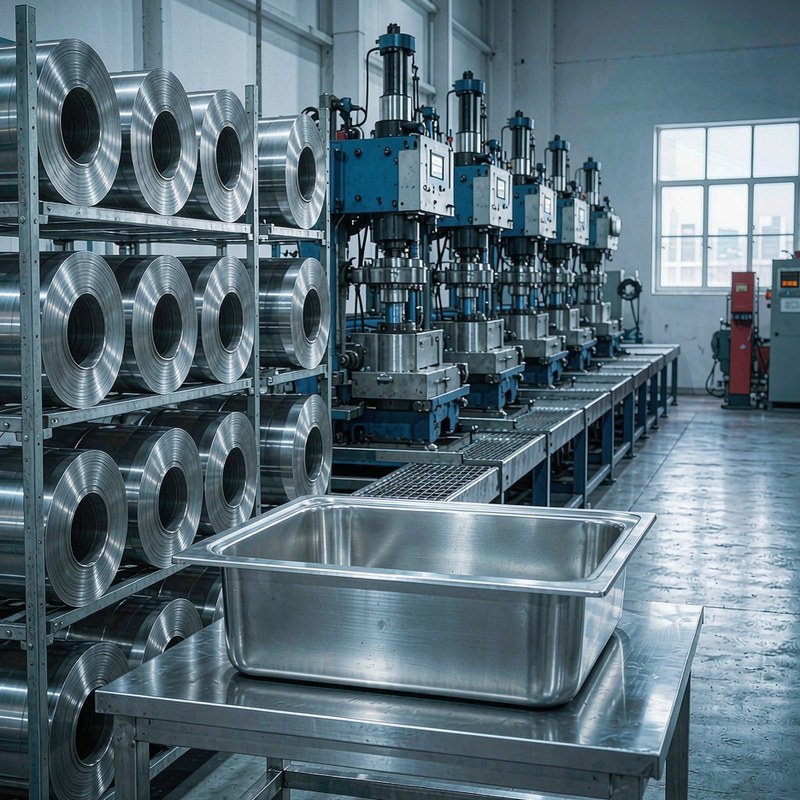
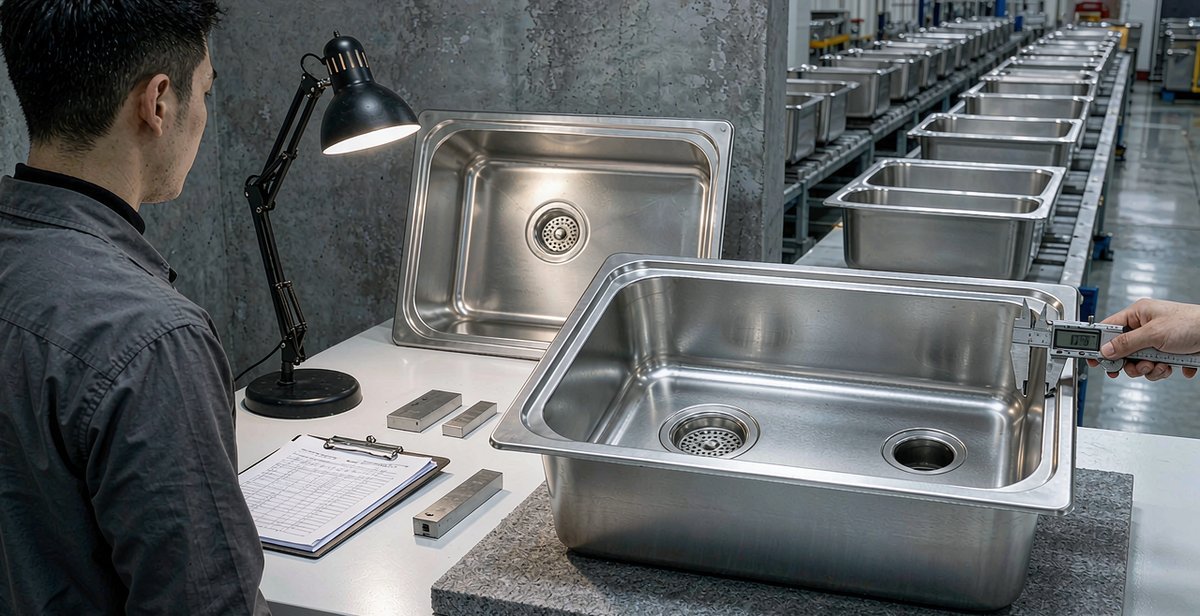
Deep-draw press line and 304 coil stock: the environment every OEM and ODM sink project converges into. Photo: Samsink production floor.
OEM vs ODM at a Glance: What Actually Changes
Buyers often treat OEM and ODM as pricing tiers. They are better understood as different answers to one question: who owns the design? Everything else — tooling risk, IP protection, MOQ, launch speed — follows from that answer.
Dimension
OEM (you own the design)
ODM (factory owns the design)
Starting point
Your drawings, CAD files or a physical sample to reverse-engineer
Factory’s existing mold library (500+ molds at Samsink)
Tooling
New deep-draw die if no existing mold fits; buyer usually funds it
Zero tooling cost when an existing mold is reused
Design ownership & IP
Your design; exclusive molds are never reused for other clients; NDA before drawings are shared
Factory design; exclusivity ends at your logo, packaging and feature options
Typical MOQ
Higher on new tooling; lower on laser-logo programs
Lower — logo etching programs can start around 50 units
Time to market
Longer: DFM, tooling (4–8 weeks) and T1 approval before production
Faster: standard orders commonly ship in 4–6 weeks
Best for
Brands with unique specs, foodservice chains, proprietary workstation sinks
Distributors and e-commerce sellers building a private label range quickly
Benchmarks compiled from Samsink program data and published ranges from sink and metal-stamping suppliers across Asia; see the Samsink manufacturing process page for the first-party figures.
Both Models Run the Same Four Gates
Whether the design originates from your engineering team (OEM) or from the factory’s mold library (ODM), the project crosses the same quality gates. Understanding them lets you hold your supplier accountable at the right moments:
Drawing — specs frozen, feasibility and DFM review signed off.
Sample — a handmade prototype proves the design; a T1 sample proves the tool.
Mass production — pilot run validated, then full-rate output and container loading.
Stage 1 — Drawing: What a Sink Factory Needs Before Quoting
A quotable sink drawing is more than an outline. The factories that quote fastest are the ones that receive a complete spec up front, because every missing parameter becomes an assumption that resurfaces as a cost. At minimum, prepare:
Bowl geometry: outer dimensions, bowl depth, and corner radius (tighter radii need more draw stages and higher tonnage).
Material: SUS304 for general kitchens; SUS316 adds roughly 30–40% to material cost but is the right call for coastal, seafood or high-chloride environments.
Gauge: 16-gauge (1.5 mm) is the heavy-duty commercial standard; 18-gauge (1.2 mm) suits lighter prep; 14-gauge (2.0 mm) for maximum-duty pot-wash applications.
Mounting and deck: undermount, drop-in or apron-front; deck thickness the rim must sit against; faucet hole layout.
Drain: commercial projects standardize on a 3.5-inch opening; confirm strainer type.
Finish and sound-deadening: brushed, satin or PVD; pad thickness and coating coverage.
Packaging: export carton — and ISTA 3A drop-test packaging if you sell online.
A serious supplier responds with a DFM (Design for Manufacture) review: draft angles, draw ratios, springback allowance and tolerance stack. This is where a good factory improves your design and a cheap one stays silent. Industry experience is consistent on one point: freeze the drawing before tooling steel is cut — late design changes are the single biggest schedule killer in custom metal projects. Samsink’s engineering team returns CAD/3D drawings for approval before any tooling investment, and cutting accuracy on the flat blank is held to ±0.1 mm.
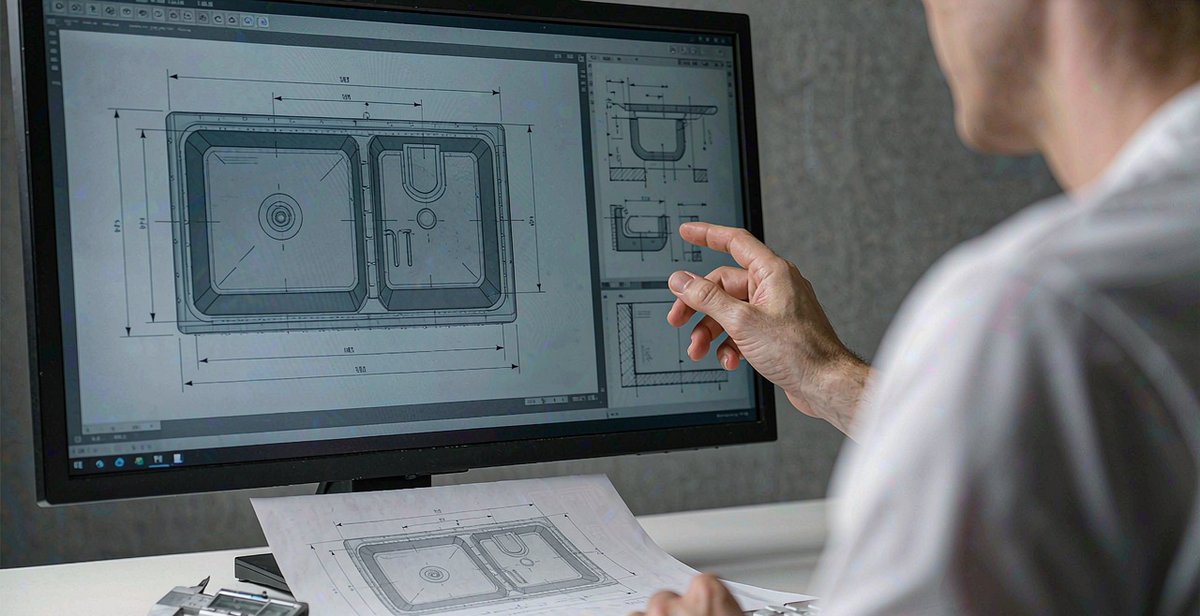
Drawing gate: a double-bowl sink layout with section views and dimensions, reviewed before tooling is quoted.
Stage 2 — Sample: Handmade Prototype vs T1 Off the Tool
Custom sink projects use two very different samples, and confusing them causes most sample-stage disputes:
Handmade prototype (pre-tool): laser-cut, folded and hand-welded from sheet to prove geometry, capacity and fit in the real countertop or worktable. Fast (days to ~2 weeks) and economical, but it does not represent the draw process’s wall-thinning or radii.
T1 sample (off the tool): the first parts produced by the actual deep-draw die. This is the sample that predicts mass production. Expect imperfect cosmetics; T1 exists to verify dimensions, wall-thickness distribution and drain positioning, not to be beautiful.
Professional practice: measure T1 parts against the drawing with a CMM or calibrated gauges, record results, then sign a written approval. Keep a signed master sample on both sides — it becomes the physical referee for any later dispute about finish, welds or cosmetics. Samsink holds first-article inspection reports against every custom program and samples the formed depth and wall-thickness uniformity on 10% of each batch during ramp-up.
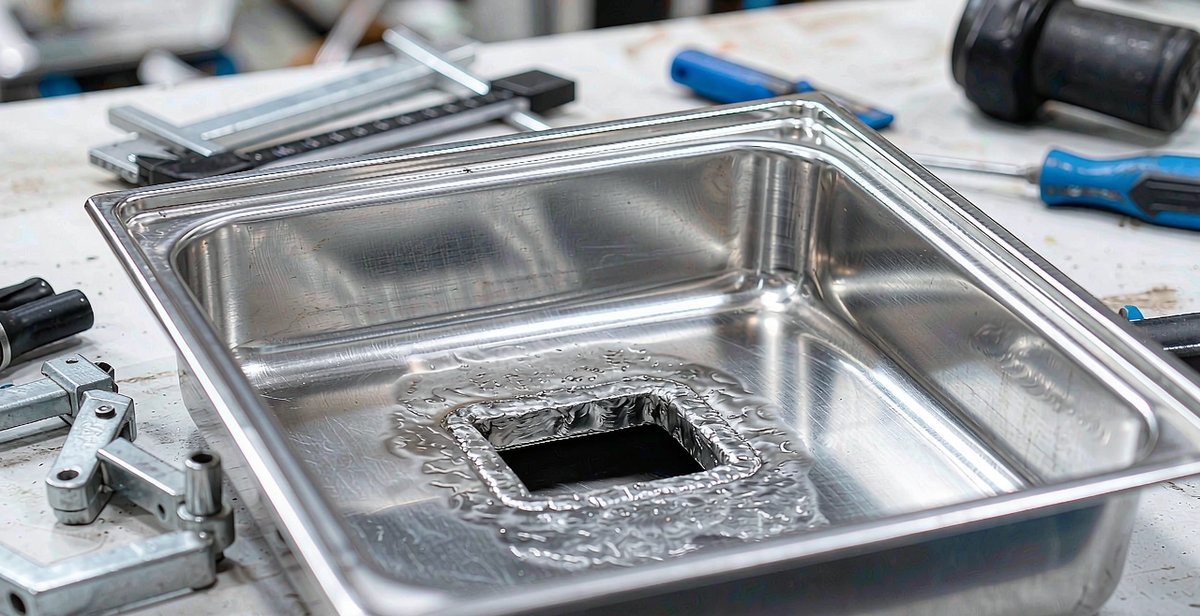
A hand-built prototype: the fastest way to validate bowl geometry before committing to tooling steel.
Stage 3 — Mold: What Deep-Drawing Tooling Really Involves
The mold is the heart of an OEM sink project. A farmhouse or deep single-bowl sink is formed by stretch drawing: a hydraulic press (800–1,200 tons at Samsink) pushes a flat blank through a die in at least two stages — initial draw, then finish draw — to prevent tearing. Key parameters buyers should ask about:
Tool material and life: properly maintained draw dies routinely exceed 100,000 cycles.
Forming accuracy: ±0.5 mm tolerance on formed geometry is a realistic factory standard.
Simulation: factories that run forming simulation before cutting steel typically cut tryout iterations by 20–30%.
Tooling cost: published ranges for a new stainless sink draw die run roughly $1,500–$5,000 depending on size, depth and workstation ledges; many suppliers rebate or amortize the fee once cumulative orders reach about 1,000–2,000 units — always ask.
Ownership: if you fund the mold, the contract should state that the tool is your property, stored and maintained at the factory, never used for other clients.
Tooling design and build typically takes 4–8 weeks, followed by 1–2 weeks for T0/T1 trials and 1–3 weeks for buyer approval and any corrections. Samsink’s published program timeline is 6–8 weeks for mold customization, supported by an in-house toolroom and a library of 500+ existing molds — which is also why many “custom” requests can be satisfied ODM with zero tooling cost.
A deep-draw die: the single largest upfront investment in an OEM sink project, and the reason drawing freeze matters.
Stage 4 — Mass Production: From First-Article Approval to Container
Once the T1 sample is approved in writing, production release should still pass through a pilot run — a small batch on the real tooling at production speed. Only then does full-rate output start. On a mature drawn-sink line each batch cycle takes about 1–2 days:
Blanking: coil is laser-cut into blanks (±0.1 mm), edges deburred, scrap 100% recycled.
Drawing: multi-stage forming under 800–1,200 t pressure at a controlled 10–20 mm/s with lubrication.
Trimming, punching, welding: rim trimmed, drain and faucet holes punched (±0.5–1 mm), bowls joined by TIG/argon-arc welding at 100–150 A.
Surface: grinding removes draw marks, then hairline brushing or mirror polish to Ra 0.4–0.8 µm, optional PVD or nano coating.
Leak and dimensional QC: pressure testing, 3D scanning, final sampling at AQL-based plans; Samsink’s batch pass rate runs above 99.5% with a 20% final random inspection and inspection reports on request.
Packing: desiccant, rust-proof paper, foam protection and export cartons rated for sea freight.
Standard production orders typically complete in 4–6 weeks from order confirmation; plan ocean freight and customs on top — count total landed time, not factory lead time, when promising launch dates to your own customers.
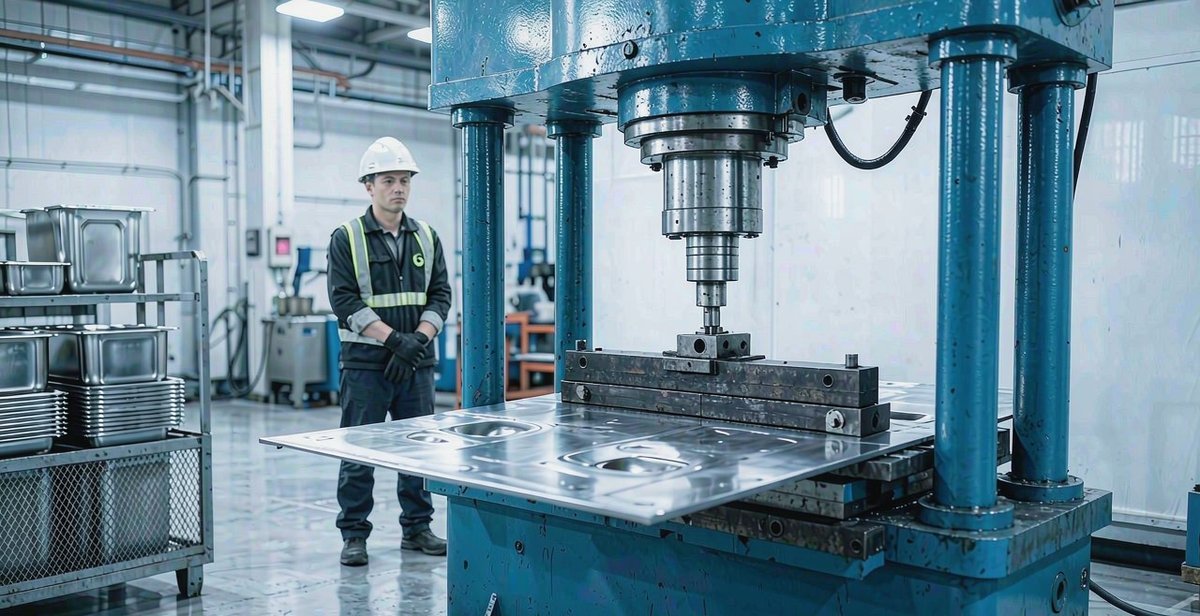
Full-rate drawing: 800–1,200 t of press force turning flat blanks into formed bowls at production speed.
Typical Timelines and Costs Across the Four Gates
Stage
Typical duration
Typical cost exposure
RFQ, DFM & drawing freeze
1–2 weeks
Engineering time (often credited against first order)
Handmade prototype
Days to 2 weeks
Sample fee, usually refundable at order
Tooling design & build
4–8 weeks
$1,500–$5,000 typical draw die; often rebated at 1,000–2,000 units
T0/T1 trials & corrections
1–2 weeks (+1–3 weeks approval)
Included in tooling fee by most factories
Pilot run & documentation
1–2 weeks
Minor
Mass production
4–6 weeks per order
Per-unit FOB price
Ocean freight & customs
3–5 weeks to US/EU
Freight, duty, buffer inventory
Ranges reflect published data from sink and stamping suppliers plus Samsink’s own program history; your confirmed schedule should always come from a written DFM review, not from this table.
Five Places Custom Sink Projects Actually Go Wrong
Changing the drawing after tooling starts. Every dimensional change after steel is cut costs weeks. Freeze at DFM; batch your feedback in one round.
Approving samples verbally. If it is not measured against the drawing and signed — with a retained master sample — it is not approved.
Ignoring wall thinning on deep bowls. Deep farmhouse draws thin the corner walls; specify minimum wall thickness in the drawing, not just outer depth.
Underestimating certification lead time. cUPC and NSF documentation for a new model can add weeks; start in parallel with tooling, not after production.
Planning factory lead time instead of landed time. Add 3–5 weeks of freight plus customs before your shelf date, and buffer inventory for the first two shipments.
Extra Requirements for Foodservice and Industrial Projects
A custom sink manufacturer for foodservice works to different constraints than a kitchen-sink brand. Commercial kitchens buy sanitation and structural performance first:
Sanitation design: NSF/ANSI 2-oriented construction — coved inner corners (R10–R15) that eliminate dirt-collecting seams, sealed welds, sloped drainboards.
Structure: 16-gauge (1.5 mm) bowls as the heavy-duty standard, 14-gauge (2.0 mm) for pot-wash; reinforced underframes, adjustable bullet feet.
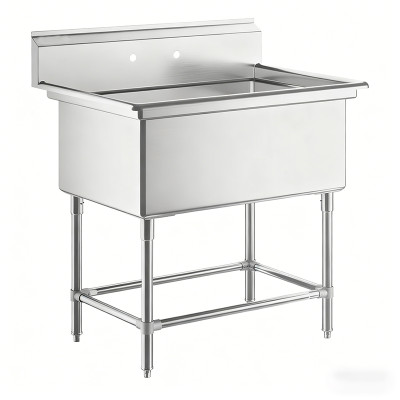
Workflow fit: compartment count matched to the wash-rinse-sanitize sequence, drainboard orientation matched to the kitchen line, splash protection up to 12 inches.
Industrial kitchen OEM programs (mop sinks, trough sinks, pet-wash and custom fabrications) are usually better served by Samsink’s handmade/welded process than by deep-draw tooling — non-standard sizes with MOQ as low as 5 pieces, 1–3 week production.
Dimensional QC before packing: measured, recorded and signed — the habit that prevents disputes a year into production.
Certifications and Documents to Request Before Production
Market certification: cUPC to ASME A112.19.3 / CSA B45.4 for North America; NSF/ANSI sanitation compliance for commercial foodservice.
Factory systems: ISO 9001 certificate — and a real audit of the toolroom and inspection lab, not just the showroom.
Material traceability: mill test reports (MTRs) matching SUS304/SUS316 spec for every heat lot.
First-article package: ballooned drawing with measured results, material certificates, and the signed master sample agreement.
Per-model certification claims should be verified, not assumed: ask the supplier to confirm the applicable certificate for your specific model on the quotation.
How Samsink Runs OEM and ODM Sink Programs
Samsink has manufactured stainless steel sinks in Foshan since 1995, with a second production base in Bangkok, Thailand since 2018. The numbers behind the four gates described above:
8 production lines, 100,000+ pcs monthly capacity across drawn and handmade processes
500+ existing molds — many ODM projects launch with zero tooling cost
1,000+ customers served; MOQ from 5 pcs on handmade custom fabrication
ISO 9001, cUPC, NSF/ANSI; T304/T316 with material traceability
Pre-RFQ Checklist: What to Send Before You Ask for a Price
Bowl outer dimensions, depth and corner radius (mm or inches, tolerances if critical)
Material grade and gauge (304/316; 14/16/18-gauge)
Mounting type, deck thickness and faucet hole layout
Drain opening and strainer specification
Finish, sound-deadening pads and coating requirements
Packaging spec (export carton or ISTA 3A for e-commerce)
Target annual volume and first order quantity
Destination market and required certifications
Frequently Asked Questions
Is OEM or ODM cheaper for a custom stainless steel sink?
ODM is cheaper to start because existing tooling carries no mold fee and production begins sooner. OEM costs more upfront (tooling typically $1,500–$5,000) but wins on unit price and differentiation at volume, especially when the mold fee is rebated at 1,000–2,000 cumulative units.
Who owns the mold in an OEM sink project?
The buyer who funds the tool should own it. Put ownership, storage, maintenance and the no-reuse guarantee in the purchase agreement before sharing drawings, and sign an NDA first.
How long does a custom sink take from drawing to mass production?
A realistic OEM program runs about 8–14 weeks from frozen drawing to production release: 4–8 weeks tooling, 1–2 weeks T1 trials, 1–3 weeks approval and corrections, 1–2 weeks pilot and documentation. Add 4–6 weeks for each production order and 3–5 weeks of ocean freight.
What is a T1 sample and why does it matter more than a prototype?
A T1 sample is the first part made by the production tool. It reveals draw quality, wall thinning and true tolerances that a handmade prototype cannot show. Approve it in writing with a retained master sample.
Can I combine OEM and ODM in one product range?
Yes — and most successful private label ranges do: ODM bodies from the existing mold library for fast-moving sizes, plus one or two OEM hero models with exclusive tooling for differentiation.
Ready to Move From Drawing to Container?
Send Samsink your drawing, sample or even a sketch — the engineering team replies with a DFM review, milestone schedule and quotation, typically within 24 hours.